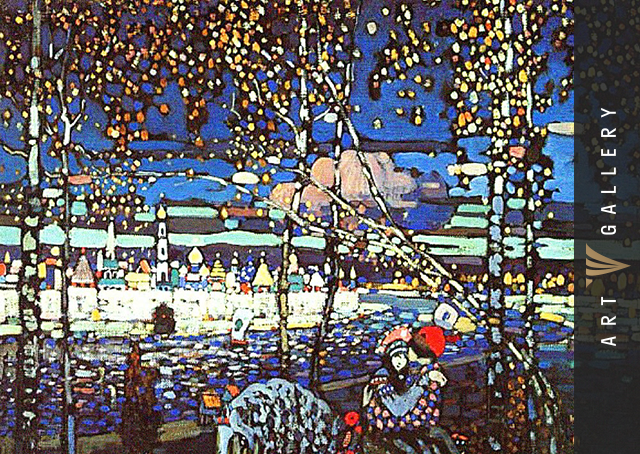
Pointillism Art (c.1884-1900)
What's Pointillism Art? - Characteristics
In fine art, the term"pointillism" (from the French word"point" significance"scatter") describes a technique of Neo-Impressionism painting, where hundreds of small dots or dashes of pure color are applied to the canvas, or other soil, to be able to create maximum luminosity. That is, rather than mixing color pigments and applying the mixture onto the painting, the Pointillist relies to combine the optically and applies small dots of pure color that is unmixed directly. Viewed at the right distance, (supposedly 3 times the diagonal measurement) the dots of color give a richer and more subtle effect than could be accomplished by conventional techniques. Pointillism (actually an offshoot of Divisionism) was the most influential style of Post-Impressionist painting (1880-95) and has been practised by Post-Impressionist painters by a number of different schools. Italian Divisionism, headed by Vittore Grubicy De Dragon (1851-1920), was particularly active.
Does Pointillism Relate to Neo-Impressionism and Divisionism?
Strictly speaking Pointillism refers only to the type of mark made on the canvas (the dot). On might just as easily call it"dottism". The actual concept of mixing paint-pigments optically, rather than on a palette, is known as Divisionism (or Chromoluminarism). To confuse matters further, Pointillism was the painting style known as Neo-Impressionism's signature style. To put it another way, Neo-Impressionist painters employed brushwork, in order to make the luminous colours and consumed Divisionism's colour theories.
Note the dots of unmixed color aren't actually combined by the eye, which sees them as colours. However, they do appear to oscillate or vibrate, creating a sort of shimmer.
Who Invented Pointillism?
The creator of Pointillism was Georges Seurat (1859-91), a model student at the Ecole des Beaux-Arts at Paris. A traditional, and traditional painter, he rejected a style of colour and painting, Impressionism depending on the artist's responses, in favour of a more scientific method he developed around 1884 and called Chromoluminarism. Based on the scientific colour theory of the French chemist Michel Eugene Chevreul (Law of Simultaneous Colour Contrast, 1839), and the American physicist Ogden Rood (Modern Chromatics, 1879), the method was used to some degree from the Impressionist painters, but only on an ad hoc basis, and it was not developed systematically until Seurat. (Compare Monet's strategy, see: Attributes of Impressionist Painting 1870-1910.)
Seurat's main disciple was the prior Impressionist Paul Signac (1863-1935). A coastal landscape artist was attracted by the scientific method behind Divisionism and Pointillism and, after Seurat's death in 1891, he became the leading exponent of the Neo-Impressionist movement. Besides watercolours and oil paintings, he produced a number of lithographs, etchings and pen-and-ink sketches composed of tiny. A strong supporter of artists Signac, within the Post-Impressionism motion was allegedly the first person to buy a painting.
Who Are The Greatest Pointillist Painters?
Signac and seurat stay Pointillism's greatest exponents. As well as them, the Impressionist Camille Pissarro (1830-1903) was also an active member of the school, as was Henri-Edmond Cross (1856-1910), and Maximilien Luce (1858-1941) who portrayed industrial culture and working-class scenes. Other artists associated with the idiom include: the Fauvist leader Henri Matisse (1869-1954); Albert Dubois-Pillet (1846-90), a self-taught artist that adapted Pointillism to landscape scene and naturalist subjects; Charles Agrand (1854-1926), that was more of a lyrical painter; Giuseppe Pelizza da Volpedo (1868-1907), the leading Italian Pointillist; and Theo van Rysselberghe (1862-1926) the founder of Les Vingt, a group of progressive virtosuart.com Post-Impressionists. Even Van Gogh (1853-90) painted sometimes in a Pointillist style.
Legacy
Neo-Impressionism had a remarkable influence on the next generation. Its focus on colour stimulated the development of this Fauvism college - and therefore German expressionism - thus playing a significant role in the evolution of modern art. NOTE: To see how Monet's, Seurat's and Signac's so-called'naturalism' led paradoxically to abstraction, visit: Realism to Impressionism (1830-1900).
Famous Pointillist Paintings
Georges Seurat
Fishing at The Seine (1883) Museum of Modern Art, Troyes
Bathers at Asnieres (1883-4) National Gallery, London
The Models (1888) Barnes Foundation, Merion, PA
Grey Weather, Grande Jatte (1888) Philadelphia Museum of Art
Paul Signac
The Jetty at Cassis (1889) Metropolitan Museum of Art New York City
Women at the Well (1892) Musée d'Orsay, Paris
The Papal Palace, Avignon (1900, Musee d'Orsay, Paris)
The Port of Saint-Tropez (1901) The National Museum of Western Art, Tokyo
Grand Canal, Venice (1905) Toledo Museum of Art, Ohio
Theo van Rysselberghe
Madame Maus (1890) Musees Royaux des Beaux-Arts, Brussels
For additional Dutch luminists, visit: Post-Impressionism in Holland (1880-1920).
Henri-Edmond Cross
Nocturne (1896) Petit Palais, Geneva
Maximilien Luce
The Foundry (1899) Kroller-Muller Museum, The Netherlands
Camille Pissarro
Self-Portrait (1903) Tate, London
Henri Matisse
Luxe, Calme Et Volupte (1904-5) Musee d'Orsay
Neo-Impressionist works hang in lots of the best art museums in Europe and America. See: Art Museums in Europe, for details of European sets containing Pointillist works.